Why Take Overpriced Listings?
Aug 02, 2026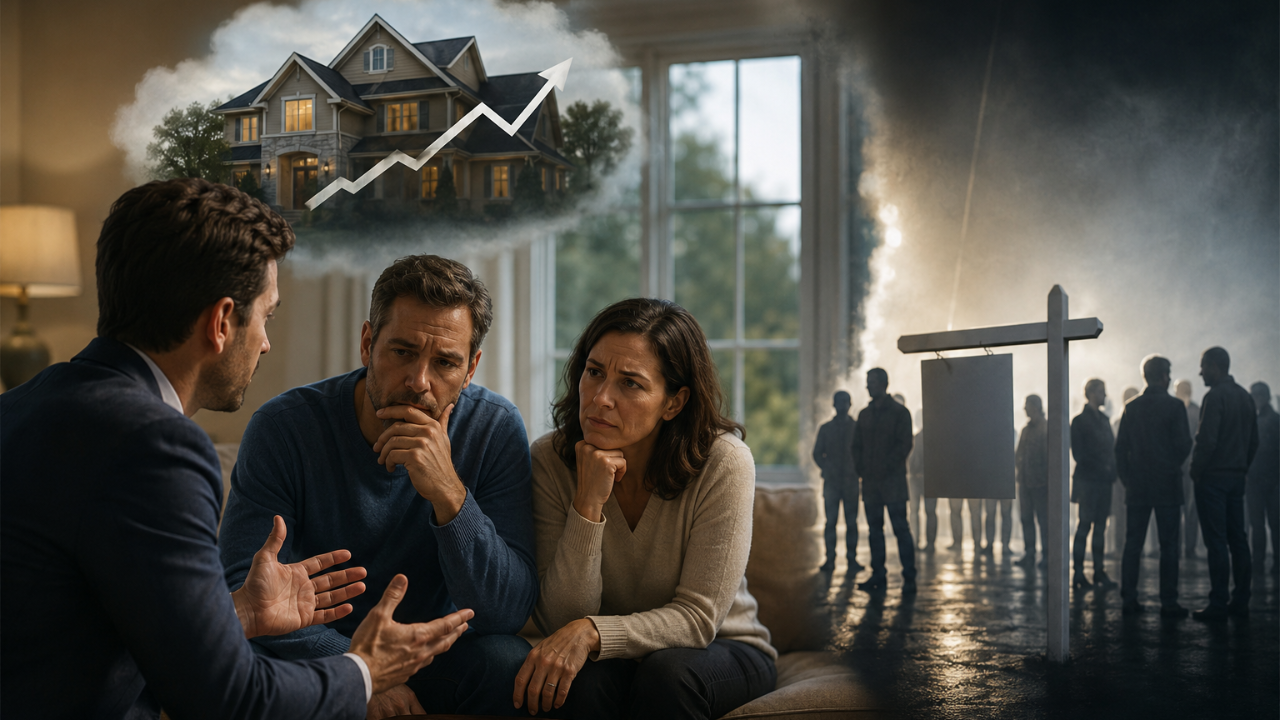
You know you shouldn't take overpriced listings.
You do it anyway.
Why?
Every experienced agent knows the same thing.
Taking an overpriced listing almost never ends well.
The first few weeks are quiet.
Showings slow.
Feedback becomes vague.
The seller becomes frustrated.
The relationship deteriorates.
Eventually the price comes down...
Often after the home has already lost the one thing you can never get back.
Attention.
You know this.
You've lived it.
So here's the obvious question.
If you already know what happens...
Why do you keep doing it?
Most agents answer this question too quickly.
"I needed the listing."
"I didn't want another agent to get it."
"I thought I could talk them down later."
"They weren't ready."
"I wanted market share."
Those are reasons.
They are not causes.
The cause lives somewhere much deeper.
The Conversation Was Never About Price.
It was about uncertainty.
The seller asks one simple question.
"What is my home worth?"
It sounds like a pricing question.
It isn't.
It's an uncertainty question disguised as a pricing question.
What the seller is really asking is this:
Can you make me feel certain before I make this decision?
Unfortunately...
You can't.
Because certainty doesn't exist yet.
The market hasn't spoken.
No buyers have responded.
No offers exist.
Nothing objective has happened.
The only honest answer is:
"I don't know yet."
But that's the one answer almost nobody wants to give.
The Real Pressure Isn't Coming From The Seller.
It's Coming From You.
When a seller wants certainty...
You start wanting certainty too.
Not because you're weak.
Because you're human.
The human brain is remarkably uncomfortable with uncertainty.
It wants closure.
Immediately.
It wants the conversation to end.
It wants agreement.
It wants relief.
So when the seller says,
"I think it's worth $2.3 million."
Your brain immediately starts solving a completely different problem.
Not...
"What pricing strategy gives us the highest probability of creating buyer competition?"
Instead...
"How do I keep this relationship alive?"
Those are two entirely different conversations.
One serves the market.
The other serves your nervous system.
Every Overpriced Listing Begins As Emotional Relief.
Not Strategic Thinking.
Think about what happens in the living room.
The seller feels relief because you agreed.
You feel relief because you got the listing.
Everyone leaves feeling better.
For about three days.
Then reality shows up.
The market never agreed.
The buyers never agreed.
Only the two people sitting in the living room agreed.
The market was indifferent to the entire conversation.
This Is Why So Many Pricing Conversations Fail.
Because they're built around opinions.
"My home is worth..."
"I believe..."
"I feel..."
"The last agent said..."
"Zillow says..."
Every opinion gets another opinion.
Every opinion invites debate.
Nobody actually knows.
The conversation becomes an attempt to predict what buyers will eventually do.
The irony?
The buyers are the only people not in the room.
The Market Doesn't Care About Opinions.
The market only responds to evidence.
Evidence isn't how confident you sound.
Evidence isn't your CMA.
Evidence isn't the seller's expectations.
Evidence is buyer behavior.
How many qualified buyers came?
How many wanted a second showing?
How many wrote offers?
How quickly did they act?
Did buyers compete?
That's the evidence.
Everything else is simply a hypothesis.
So Why Do Smart Agents Keep Taking Overpriced Listings?
Because they are trying to remove uncertainty before uncertainty can actually be removed.
Read that again.
You are solving the wrong problem.
The goal isn't to predict value.
The goal is to create the conditions in which value reveals itself.
Those are not the same thing.
One depends on your opinion.
The other depends on the market.
This Changes Everything.
Instead of asking...
"What is this home worth?"
Ask...
"What initial pricing position gives us the highest probability of creating the buyer behavior necessary for the market to reveal what this home is actually worth?"
That's a completely different conversation.
One is prediction.
The other is discovery.
One debates opinions.
The other designs an experiment.
One depends on confidence.
The other depends on evidence.
Here's The Part Most Agents Miss.
Taking an overpriced listing isn't primarily a pricing mistake.
It's a behavioral mistake.
It's what happens when your need for immediate relief becomes stronger than your commitment to long-term resolution.
The listing isn't overpriced because you don't understand pricing.
It's overpriced because uncertainty became uncomfortable.
And discomfort made the decision.
The Best Pricing Conversations Feel Different.
They don't promise certainty.
They don't argue opinions.
They don't pretend anyone already knows the answer.
Instead, they acknowledge something both honest and liberating.
Neither of us knows exactly what the market will pay today.
But together, we can create the conditions that allow the market to tell us.
That isn't weaker expertise.
It's higher expertise.
Because the highest level of expertise isn't pretending to know what cannot yet be known.
It's creating the conditions in which reality reveals itself.
That's what great pricing has always been.
The industry just forgot.
Get free coaching in your inbox every week
Stay focused on what truly matters with key highlights and insights from all our coaching programs.